
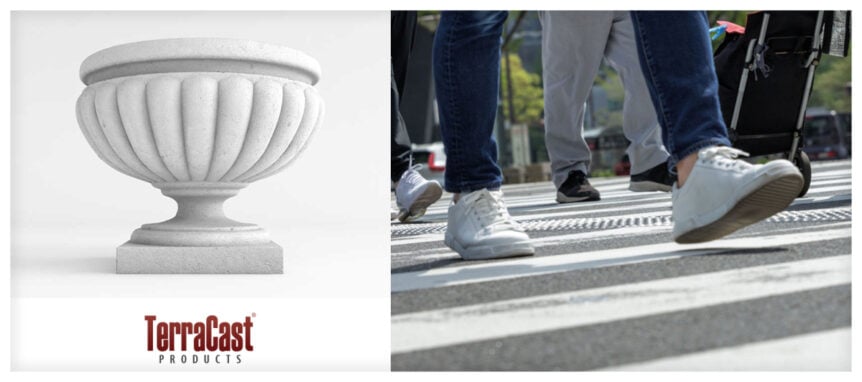
As cities continue to prioritize pedestrian safety and multimodal transportation, intersections have become a major focus of urban design improvements. Busy crossings are among the most common locations for conflicts between pedestrians, cyclists, and vehicles, particularly in dense urban environments where visibility is limited. To address these challenges, municipalities are increasingly adopting daylighting strategies and integrating streetscape elements that improve sightlines, organize traffic flow, and create safer public spaces.
Daylighting removes visual obstructions near intersections, typically by eliminating parking spaces closest to crosswalks. When combined with streetscape elements such as planters, curb extensions, and pedestrian buffers, daylighting becomes part of a broader safety strategy that helps define space more clearly and improve awareness for all users.
Why Visibility Matters at Intersections
One of the leading causes of intersection-related accidents is limited visibility. Parked vehicles near corners can block drivers from seeing pedestrians preparing to cross and prevent pedestrians from seeing approaching traffic. Cyclists are also more vulnerable when sightlines are obstructed.
Daylighting addresses this issue by clearing the area closest to the intersection, creating a more open field of view. Drivers have more time to react, pedestrians can better judge traffic conditions, and cyclists become more visible as they approach crossings.
This improved visibility is especially important in areas with high pedestrian traffic, schools, transit stops, and mixed-use corridors where multiple transportation modes interact constantly.
Moving Beyond Painted Curbs
Many cities initially implement daylighting using painted curbs or signage to restrict parking near intersections. While these methods establish the rule, they may not always create strong visual or physical reinforcement. In high-demand parking areas, compliance can become inconsistent over time.
As a result, municipalities are increasingly incorporating physical streetscape elements into daylighting projects. Planters, flexible barriers, and curb extensions help define the restricted area more clearly while contributing to the overall streetscape design.
These elements transform what would otherwise be empty curb space into intentional safety zones that support both function and aesthetics.
The Role of Planters in Daylighting Design
Planters are becoming a popular component in daylighting projects because they provide visibility, flexibility, and visual improvement at the same time. When positioned near intersections, they help establish a clear boundary that discourages parking and reinforces pedestrian space.
It is important to note that planters are not crash-rated barriers and are not intended to stop vehicles. Their value comes from spatial definition and visual presence. By occupying space that was previously used for parking, they help communicate how the intersection is intended to function.
In addition to supporting safety goals, planters introduce greenery into urban environments and soften the appearance of hardscape-heavy streets. This contributes to a more welcoming pedestrian experience while maintaining the practical benefits of daylighting.
Combining Daylighting with Other Streetscape Improvements
Daylighting is most effective when integrated into a broader streetscape strategy. Many cities pair daylighting with curb extensions, protected bike lanes, improved crosswalks, and pedestrian plazas to create safer and more organized intersections.
These combined improvements help reduce turning speeds, shorten pedestrian crossing distances, and clarify movement patterns. Streetscape elements such as planters can also help guide cyclists and pedestrians through the space more predictably.
Because these elements can often be installed without major roadway reconstruction, they provide municipalities with a flexible way to improve safety while managing budgets and construction timelines.
Supporting Flexible and Phased Urban Improvements
One advantage of using streetscape elements in daylighting projects is adaptability. Lightweight planters and similar elements can be repositioned or adjusted as traffic patterns and community needs evolve. This flexibility is especially useful for pilot programs, temporary installations, or phased infrastructure upgrades.
Cities can test intersection layouts before committing to permanent construction, allowing planners to evaluate how changes affect traffic flow and pedestrian behavior. Once successful configurations are identified, they can be refined or expanded into long-term streetscape improvements.
This approach allows municipalities to implement meaningful safety upgrades more quickly while maintaining the ability to adapt over time.
Creating Safer and More Connected Urban Streets
As cities continue to rethink street design, daylighting is becoming an increasingly important tool for improving intersection safety. By removing visibility obstructions and incorporating supportive streetscape elements, municipalities can create intersections that are safer, clearer, and more comfortable for everyone who uses them.
Planters and other flexible streetscape features help reinforce these improvements while contributing to the visual quality of the urban environment. Their ability to define space, support safety goals, and adapt to changing needs makes them a valuable part of modern intersection design.
TerraCast® resin planters are designed to support these types of urban safety and streetscape applications, offering durable, Made in the USA solutions for high-traffic public environments. To learn more about integrating planters into daylighting and intersection improvement projects, you can connect with the TerraCast® team here.